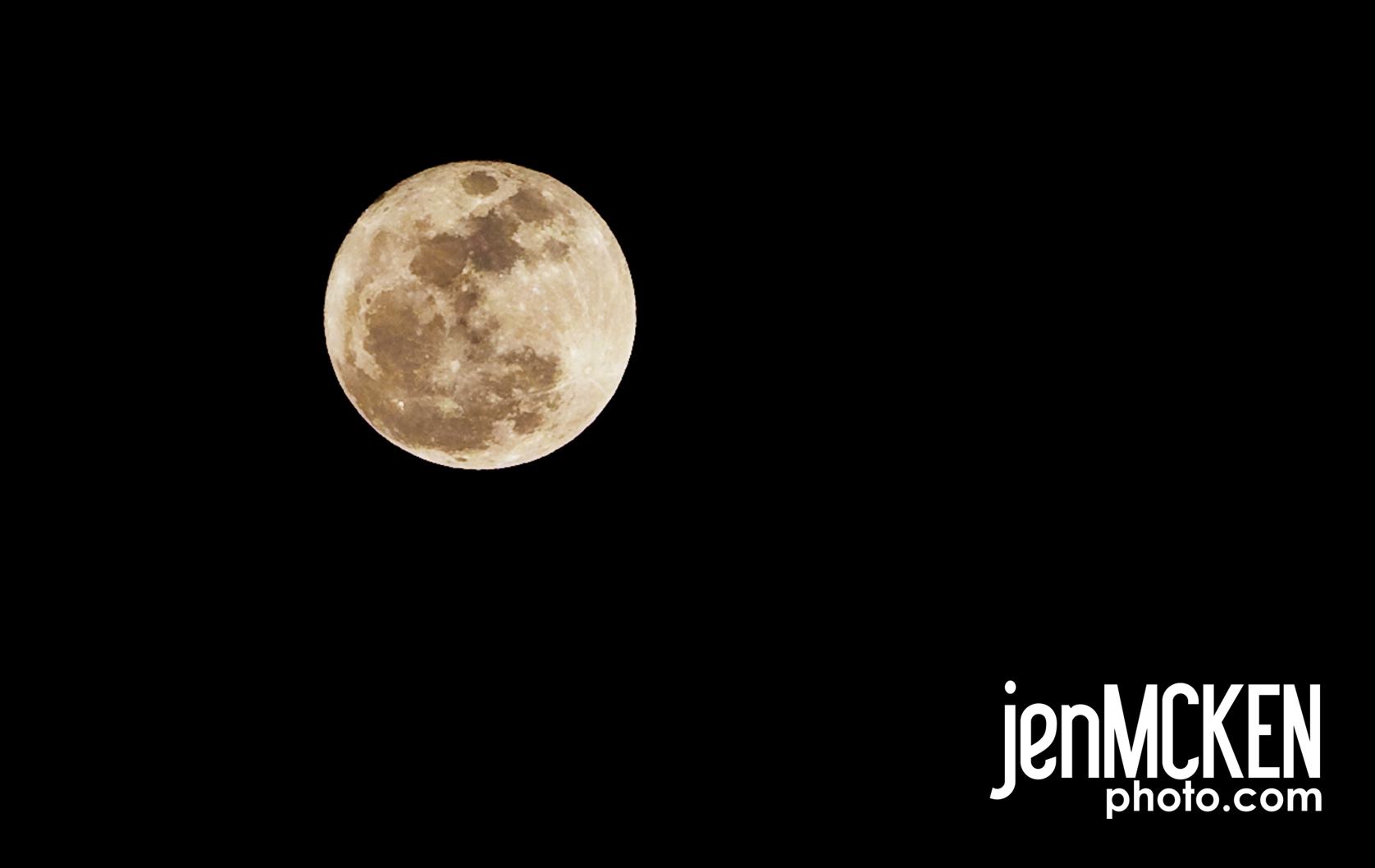
I know this isn’t typical of the things you would regularly see on the blog but I thought last night was a fantastic chance to capture a 14% fuller moon! That may not seem like much of a difference (and compared to the distance it’s not), but the diameter of the moon is only 2,159 miles. That means the moon will be over 7.5 diameters closer to Earth than average. AND because I’m such the party animal on a Saturday night, the entire family went out to try to take a few shots of the Super Moon…..just like every other person in the world! Luckily this time when something “cool happened in the sky” it was a clear night-other times we haven’t been so lucky. I’m not 100% happy with what I got, I really wish I would have caught it near the horizon when it appeared to be larger and “prettier” but I tried! And I won’t lie, I’m shooting a meteorologists wedding in April and I kinda wanted to impress them!!! (Hi Jennifer and Michael)
So I thought (and I realize I should have done this BEFORE yesterday) hey, why not share a few ways to get greatmoon photos-not JUST for a supermoon but for any moon. So here goes folks:
Avoid digital zoom on point and shoots
Digital zoom on point and shoots and camera phones generally creates a pixelated hot mess. It’s better to take the shot full size and then crop in post.
Try to get a shot of the moon closest to the horizon
They consider this the moon’s “Magic Hour” and gives you the best opportunity to grab a shot of the moon in a surrounding landscape with some sunlight. It’s also the best time to get interesting cloud cover over the moon and to capture a more orange coloured moon. Here’s a cool site to find out when the moonrise is where you plan to shoot.
Place the moon in a scene (if you don’t have a long lens)
If you don’t have a super telephoto lens, taking a picture of the moon by itself will look like a little white fuzzy dot int he sky (Don’t lie, you know you’ve tried it) Instead, capture the moon as it rises over a scenic landscape or city scape. City folk, can get amazing shots of the moon rising between buildings or over bridges. Us back woods folks can get awesome shots with the tree limbs or maybe a barn in the foreground.
Use a long lens (if you have one)
If you have a telephoto lens that’s 200mm or longer, now is the time to use it. If you want the moon all in focus, make sure you set your aperture to f/8.0 or narrower. If you are dealing with a shorter lens, focus more on the moon within a scene than the moon itself.
Use a tripod (This is a MUST!)
You MUST use a tripod or some other device to make sure the camera doesn’t move….such as a post, a ledge, or lean your camera against something solid. If you have a remote trigger or a release trigger, now is the time to use that too. If you don’t, then use the timer mode to avoid camera shake.
Use low ISO and a long exposure
To minimize noise, set your ISO as low as you can go. Try to stay under ISO 800 if you can and use your shutter speed to compensate. If you are shooting at moonrise you won’t need to do an exposure longer than about 3 seconds. In the dead of night, it might be longer. Don’t go beyond 25 seconds or you will get star trails and slight movement with the moon that can cause blurriness.
Use live view to get focus
Switch on live view, zoom in on the moon, and grab focus on Manual mode. You might have to increase your ISO so that you can see the moon to get focus. Once you have focus, switch to camera mode and change your settings back. I find this the easiest way to get focus.
AND lastly……Get Creative!!!! tee he he